Call for Abstracts: The ethics of research in South and Southeast Asian borderlands

Contributions are invited from early career scholars whose work focusses on South and Southeast Asian borderlands (research from borderlands of India, Bangladesh, Myanmar, and Thailand are particularly welcomed) for consideration to be published in a special journal issue about fieldwork research ethics.

Research in these contexts can present unique ethical hurdles for researchers and we are keen to hear about the diverse ways new scholars have navigated these challenges.

We encourage contributions from scholars from any field who has undertaken fieldwork research in South and Southeast Asia’s borderlands or nearby areas. Submissions from scholars from or based in South or Southeast Asia are especially encouraged.

While the special issue will focus on South and Southeast Asian borderlands, the editors do not envisage an area-specific guide to research ethics but rather hope to use South and Southeast Asian borderlands as an exemplar to highlight how researchers from different scholarly perspectives might undertake ethically sound research in similarly challenging contexts while utilising different ethical approaches. 

Contributors will be expected to contribute a working draft paper by 31 October 2021 and participate in an online workshop during December 2021. Complete papers (of 5000-7000 words) will then be required by May 2022 for an expected publication late 2022.

Please submit an article title and abstract of no more than 300 words outlining the article you wish to be considered for this collection by 30 June, 2021, as well as a brief author’s biography (150 words).

Abstract Deadline: 30 June, 2021.

Send any questions and the abstract you wish to be considered to the volume editors, Dr Ronan Lee ronan.lee@qmul.ac.uk and Dr Jenny Hedström Jenny.hedstrom@fhs.se

Why the international community needs to take urgent action to help reverse the Myanmar military coup

BOOK LAUNCH

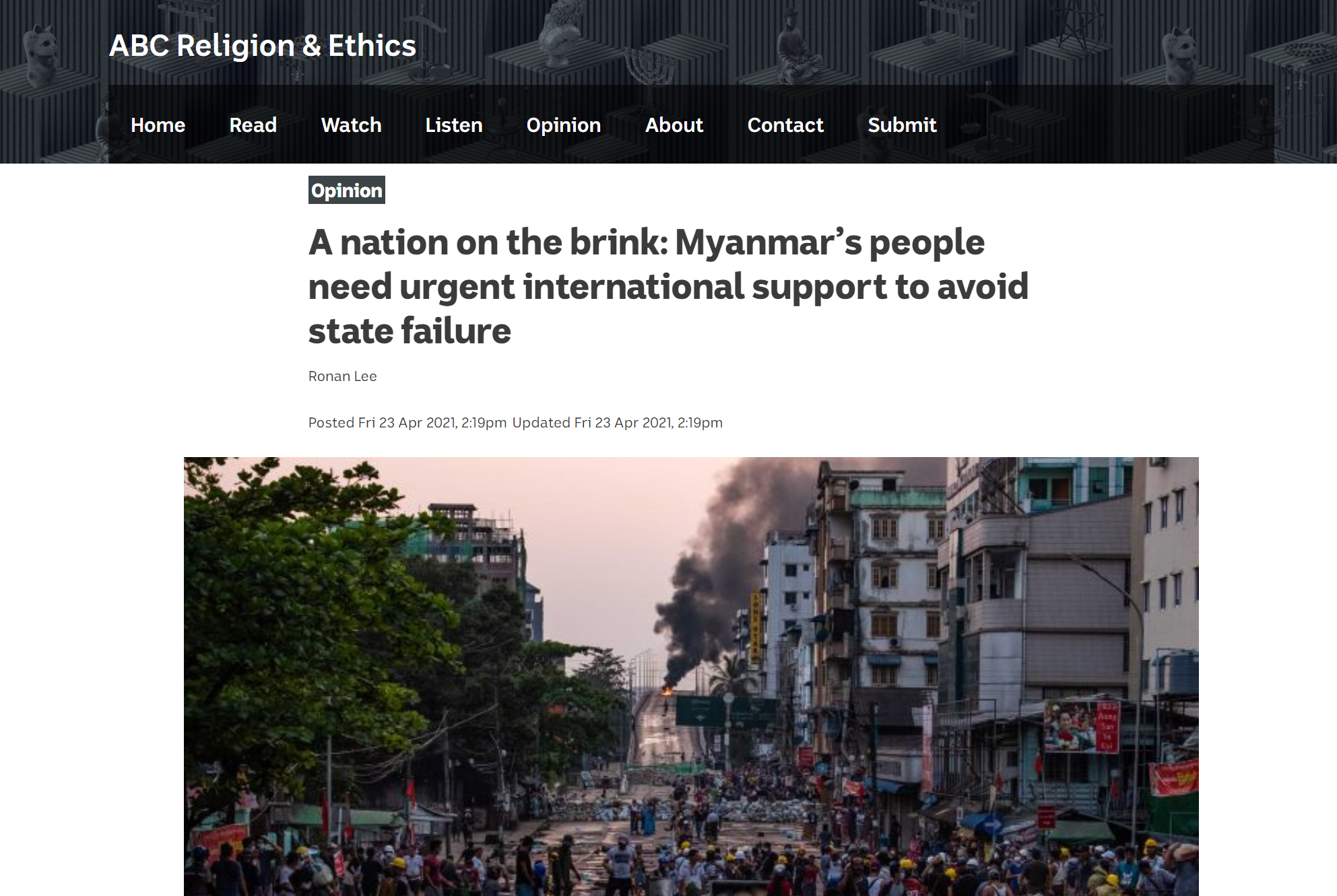
A nation on the brink: Myanmar’s people need urgent international support to avoid state failure

Last month, a video emerged out of Myanmar of soldiers beating a man before forcing him to crawl along the street like a dog on his hands and knees. It highlighted the disrespect Myanmar’s military, known as the Tatmadaw, routinely display towards civilians and was a chilling reminder of the violence and exploitation that characterised previous periods of military rule. This jarringly discomforting video will have surprised few in Myanmar, confirming what they already know too well about the country’s military. But it gives foreign observers important insight into the mindset of a soldiery who regard civilians as their inferiors and who are prepared to aggressively defend military economic and political privilege. This was far from an isolated example, and sadly, as videos of Myanmar military criminality go, it was fairly tame. READ THE FULL ARTICLE HERE.

https://www.abc.net.au/religion/myanmar-on-the-brink-of-becoming-a-failed-state/13315592

UK government must refuse to accept the legitimacy of military rule in Myanmar

Myanmar: The UN needs to urgently intervene

West ‘cannot allow events to deteriorate any further’ says author of ‘Myanmar’s Rohingya Genocide’

COVID coup: how Myanmar’s military used the pandemic to justify and enable its power grab

Myanmar’s popular leader, Aung San Suu Kyi, who has been in custody since the country’s military seized power in a coup on February 1, has been charged with a new crime: that of violating the country’s National Disaster Management Law. It’s proof, if any were needed, of the extent to which the country’s military leaders are willing to subvert the COVID crisis to their own ends.

READ THE FULL ARTICLE HERE.

https://theconversation.com/covid-coup-how-myanmars-military-used-the-pandemic-to-justify-and-enable-its-power-grab-155350

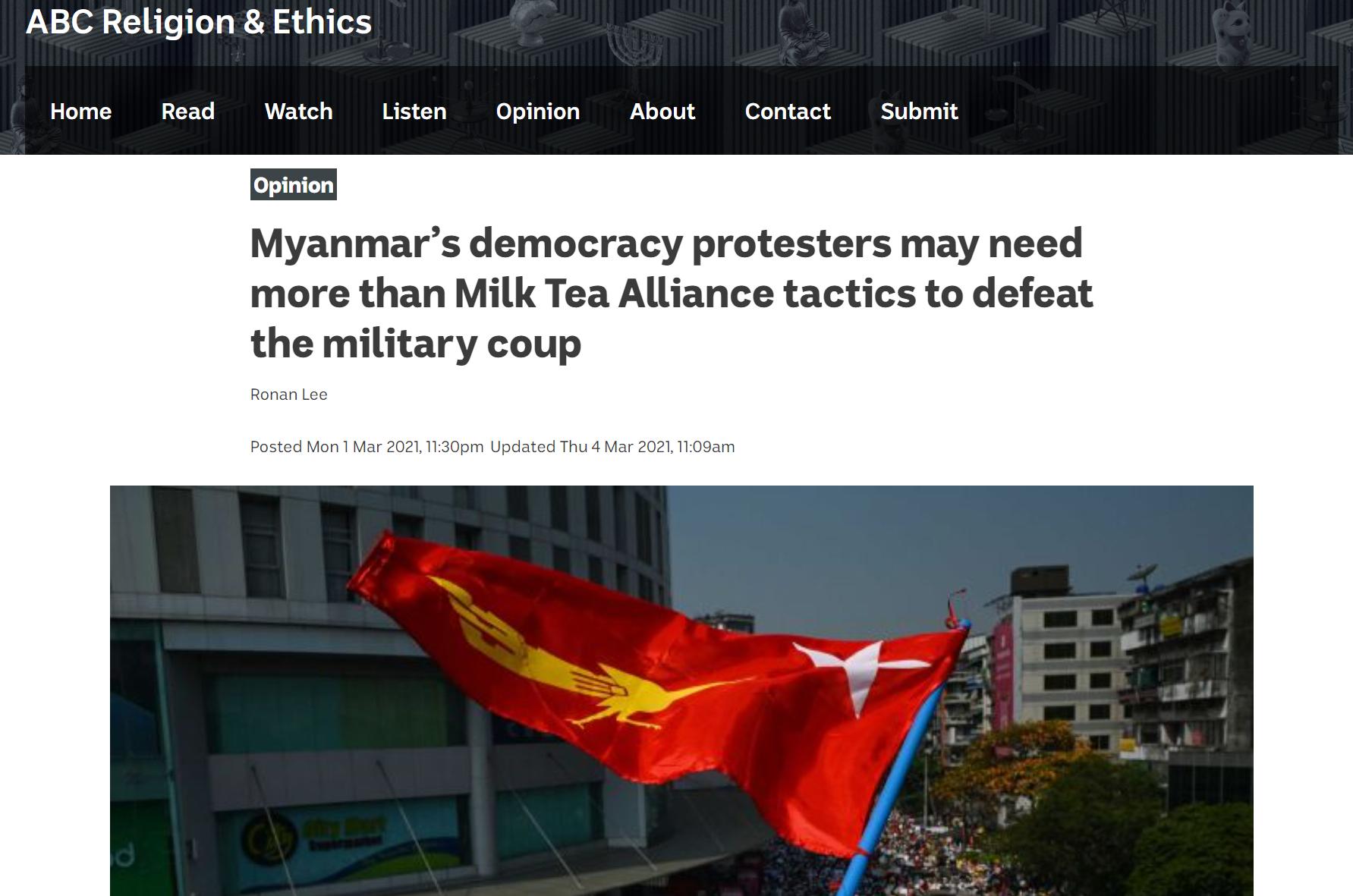
Myanmar’s democracy protesters may need more than Milk Tea Alliance tactics to defeat the military coup

A brutal crackdown could happen any day. Military violence is expected every day. Soldiers have casually killed peaceful protesters throughout the four weeks since Myanmar’s military undertook a coup to remove the country’s civilian government. Military violence has incrementally, but steadily increased. Bravely, millions of peaceful protesters still take to Myanmar’s streets to oppose the military coup and demand the release of the country’s civilian leaders including Aung San Suu Kyi. By employing tactics learned from other recent Asian protest movements, they have seemingly confounded Myanmar’s military, which has struggled to deal with the nature of protests and their scale. READ THE FULL ARTICLE HERE.

https://www.abc.net.au/religion/ronan-lee-will-peaceful-protests-be-enough-in-myanmar/13204924

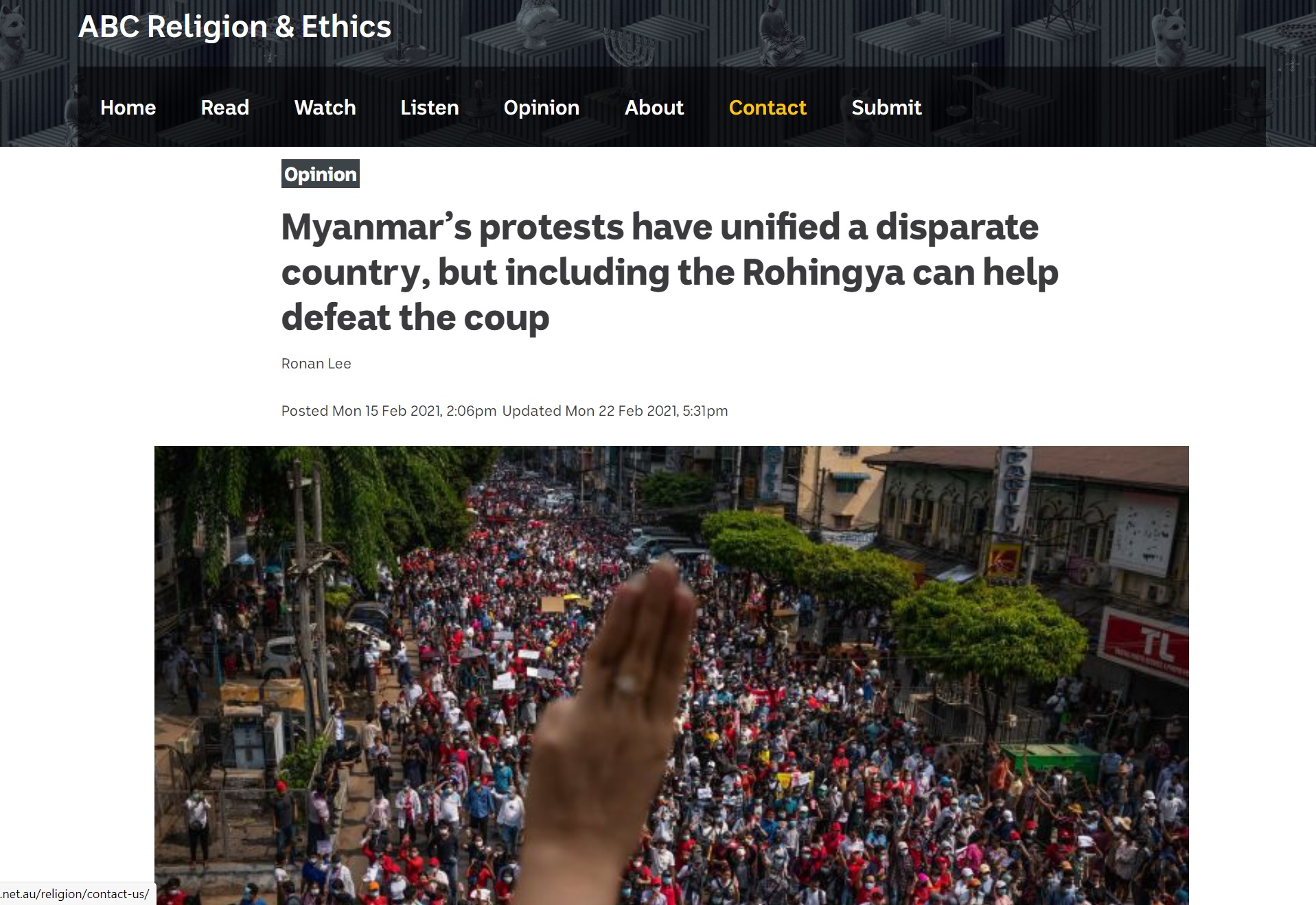
Myanmar’s protests have unified a disparate country, but including the Rohingya can help defeat the coup

This article was first published by ABC Religion & Ethics on 15 February, 2021.

Saffron robed Buddhist monks, leather clad punks, shirtless muscle-bound hunks, taffeta ballgown wearing “princes protesters”, chefs in toques, black robed lawyers, construction workers in hard hats, nurses and doctors in scrubs, tattooed martial artists, nat spirit worshipers, civil servants, drag queens, trade unionists, farmers, teachers, taxi drivers, Christians, Hindus, Muslims, the old, the young, women, men, girls and boys — this week and last, these were just some of the groups who joined the biggest protests against military rule ever seen in Myanmar. READ THE ARTICLE HERE.

https://www.abc.net.au/religion/myanmar-the-rohingya-can-help-defeat-the-coup/13155924