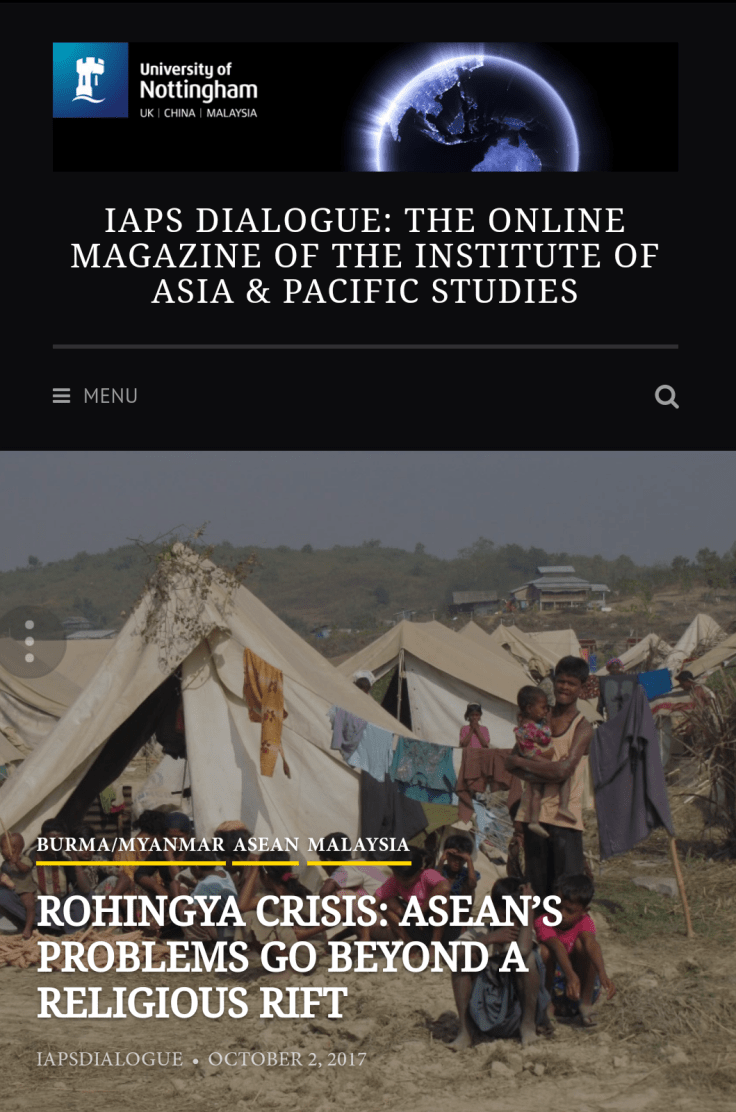
Rohingya Crisis: ASEAN’s Problems go Beyond a Religious Rift

Politics, Genocide & Human Rights

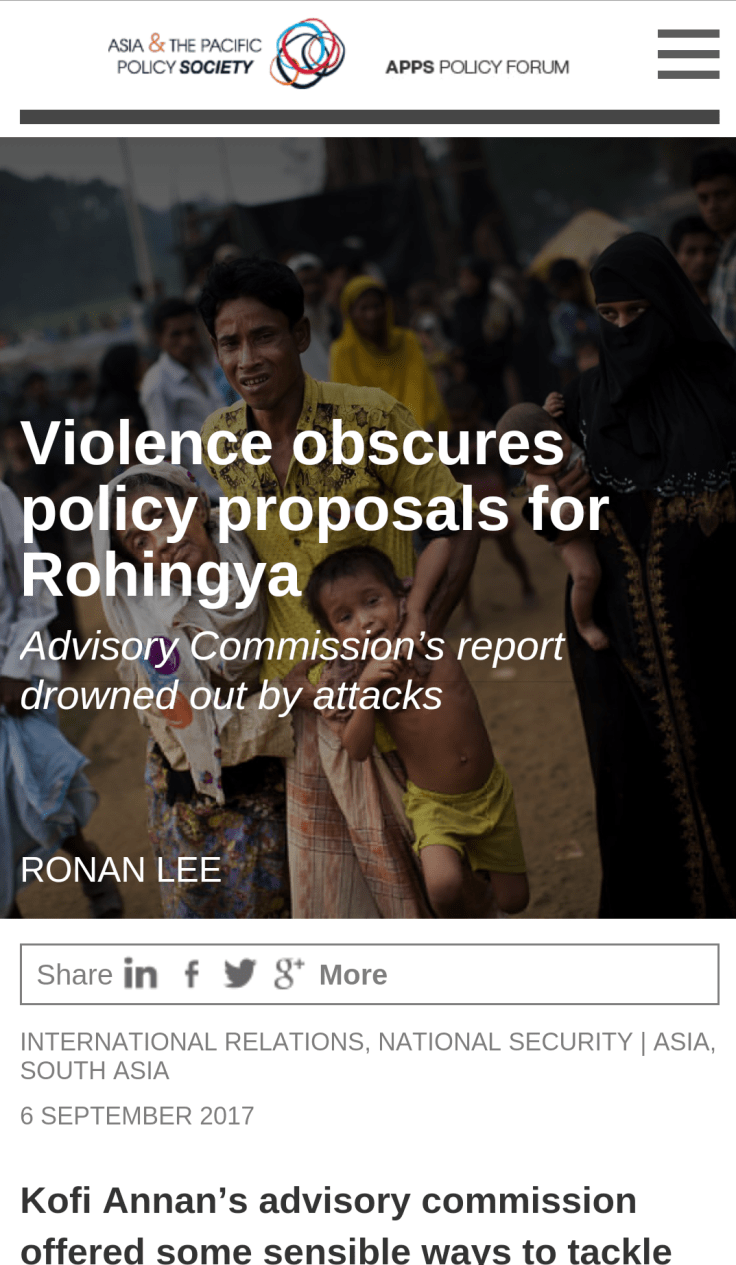 Kofi Annan’s advisory commission offered some sensible ways to tackle issues in Rakhine State, Ronan Lee writes, but will they be heard above the violence? Read the full article at PolicyForum.net here.

 Here is a link to my latest article “The Dark Side of Liberalization” published in the journal Islam and Christian-Muslim Relations: http://www.tandfonline.com/doi/full/10.1080/09596410.2016.1159045
ABSTRACT: This article describes how divisive groups have taken advantage of Myanmar’s new political and media freedoms to pursue an agenda that will limit the civil and political rights of the country’s Muslim population. The article argues that enforcement of the four Protection of Race and Religion Laws will disadvantage Myanmar’s already politically marginalized Muslim residents by creating a de facto religious test for full Myanmar citizenship rights. The article examines both the positive and negative aspects of Myanmar’s liberalizations, the nature of the ‘Protection of Race and Religion’ legislative package and how this will interact with Myanmar’s citizenship laws.

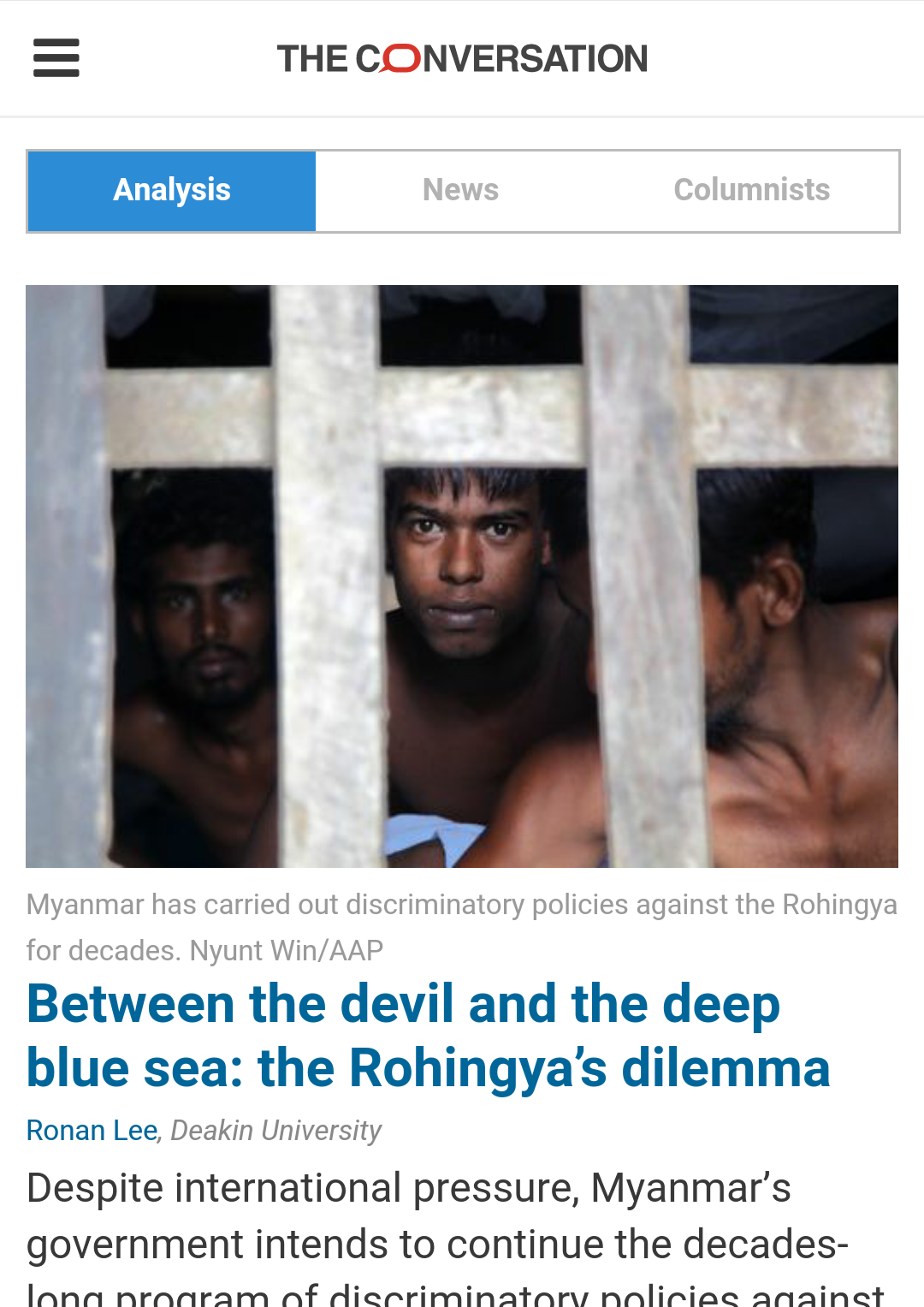 You can read my piece for The Conversation ‘Between the devil and the deep blue sea: the Rohingya’s dilemma’ here.

 Here is a link to my latest article. Published in the journal Islam and Christian-Muslim Relations: http://www.tandfonline.com/eprint/AIExfyxdwswI6nJRRBAc/full#.U3yq8CyKCP8
ABSTRACT: In Myanmar (also known as Burma), the Rohingya are a persecuted Muslim minority living mainly in northern Rakhine State. Aung San Suu Kyi, the iconic leader of Myanmar’s opposition party the National League for Democracy (NLD), is championed as the voice of the people. However, on the matter of the Rohingya’s persecution she has been notably silent. This article examines the possible reasons for Suu Kyi’s silence and argues that Buddhist–Muslim political relations in Myanmar are central to understanding the reasons behind Suu Kyi’s position on the Rohingya. It is suggested that various factors, including the history of the Rohingya in Myanmar, the NLD’s attitude towards the Rohingya, Suu Kyi’s sense of obligation to her father’s political legacy, and Suu Kyi’s views on ethnicity, are creating a political environment in which Suu Kyi is presented with pragmatic political reasons for staying silent. Given Suu Kyi has the potential to become a future national leader, an understanding of her behaviours towards a sizeable persecuted Muslim minority is important. This is particularly the case when consideration is given to the contemporary pressures on Muslims to embrace radical politics and the implications this could have for Myanmar and the region.
 Dr Ronan Lee